Warren MacKenzie: The Ceramics Legend Who Changed American Pottery
I decided to buy one of Warren MacKenzie's shino tea bowls. Holding it for the first time felt like meeting him in person. The marks he left on the clay are etched into eternity.
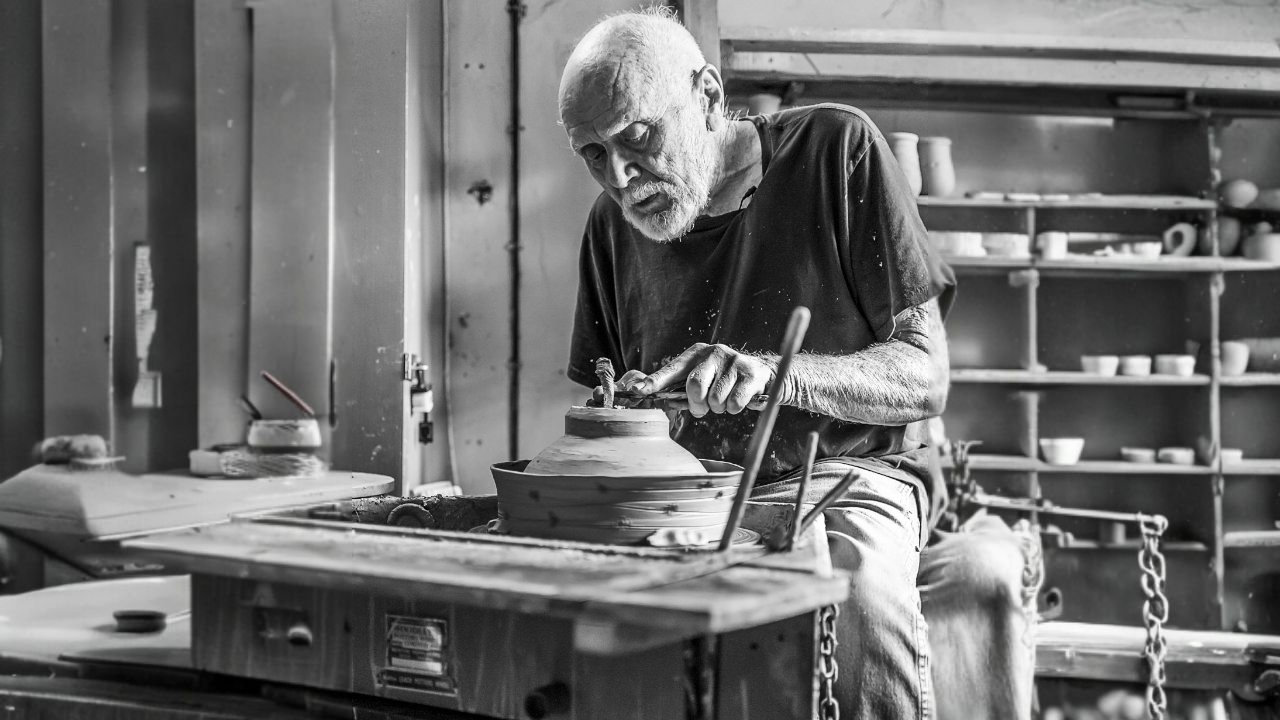
A tribute to the Minnesota potter who brought the Japanese Mingei tradition to America and proved that a handmade pot belongs on your table, not a pedestal.
By Lin Kensington | CeramicsIQ
After studying the life of Warren MacKenzie for a number of years and falling in love with the Jolly Old Fellow Potter from Minnesota, I decided to buy one of Warren MacKenzie's shino tea bowls. Holding it for the first time felt like meeting him in person. The marks he left on the clay are etched into eternity. Running my fingers over the grooves where his hands once touched, it felt like having a conversation with him. If I want to hang out with Warren MacKenzie, I can grab this bowl, brew a cup of tea, and we can sit together.
That's why I love pottery. This humble idea, carried forward by the people who came before us, that a functional form can be both humble and beautiful, is etched into my soul. And that's the legacy Warren MacKenzie left behind. Not just pots in museums. Pots in your hands.
Warren MacKenzie didn't plan to become a potter. He originally enrolled in a painting class at the Art Institute of Chicago. It was 1946, and in a twist of fate, the painting classes were full. MacKenzie took a seat in the available ceramics class.
What he found in that ceramics program frustrated him. The programs offered in America at the time were heavily technique-based, modeled on industrial ceramics, not really art. MacKenzie stumbled upon a book written by British potter Bernard Leach that would define the rest of his life.
St. Ives and the Education That Almost Didn't Happen
MacKenzie and his first wife Alix, also a ceramicist and his classmate at the Art Institute, traveled to Cornwall, England in 1949 to study with Leach. When they showed him their work, Leach turned them away. Not good enough. The way they had learned ceramics in America up until that point was basic and not up to the standards of the Leach Pottery.
The MacKenzies had a two-week reservation at a local bed and breakfast, and they spent every day hanging around the Leach Pottery, watching, asking questions. On their last night, Leach invited them to sit with him during a kiln firing from 1 to 4 AM. They talked for seven hours about politics, the world, everything except pottery.
At dawn, Leach told them he'd changed his mind. Come back in a year.
They did. And they stayed for two and a half years, eventually living in Leach's home, surrounded by pots from China, Japan, and Korea. It was there that MacKenzie absorbed the Mingei philosophy, the Japanese folk art tradition that beauty lives in everyday, functional objects made without ego.
It was also there that he encountered the work of Shoji Hamada, the Japanese master potter who had helped Leach establish the St. Ives Pottery. The intersection of East and West, of function and form, became MacKenzie's creative foundation for the next six decades.
Stillwater
In 1953, the MacKenzies bought a 50-acre farm outside Stillwater, Minnesota. It was, by Warren's account, an old defunct property with a new furnace and a well. They built a kiln in the barn and started making pots.
Warren took a teaching position at the University of Minnesota. Despite not having a formal degree, the department chair hired him based on his apprenticeship and great attitude, but told him ceramics would be the first program cut if enrollment dropped or budgets tightened. MacKenzie built it into one of the most respected ceramics programs in the country over 37 years of teaching.
Tragedy came early. Alix, who had been the decorative hand of the partnership, died of cancer in 1962. Warren was left a single father with two young daughters and a pottery to run. In 1968, the studio burned to the ground when an oil line broke during a firing. By the next evening, he and an architect friend had sketched the new building on typing paper over dinner.
He kept making pots.
Pottery for the People
MacKenzie produced roughly 5,000 pieces a year. He described them as non-repetitious domestic ware: functional pottery thrown quickly and with a looseness that left room for expression, but never preciousness.
He ran a self-service showroom on his property for decades. Pots were marked with price stickers and visitors paid by dropping money in a wicker basket. Change was on the honor system. Some of his pots sold for as little as six dollars.
He eventually had to close the showroom. People were buying at his prices and reselling online for enormous markups. It broke the thing he cared about most: that ordinary people could afford to eat and drink from handmade pots.
For periods during the 1970s and 2000s, he stopped signing his work entirely. He believed the pot itself should be the signature. When people asked if his work was art, he pushed back. Craft. Always craft.
And yet his pots are in the Smithsonian, the Metropolitan Museum of Art, the Victoria and Albert Museum, and the Japan Folk Crafts Museum. In 1981, Ceramics Monthly named him one of the 12 greatest potters in the world.
Mingeisota
MacKenzie's influence on Minnesota's ceramics community is hard to overstate. Students came to study with him at the University of Minnesota, including Mark Pharis, Randy Johnston, Jeff Oestreich, and Sandy Simon, and many of them set up their own studios in the region. They taught others. Those students taught more.
The community that grew around his philosophy became known as Mingeisota. It wasn't a brand. It was a way of living: find an affordable place in the country, build a kiln, make functional pots, keep prices fair, and let the work speak.
As one museum director put it: it wasn't just an aesthetic. It was a lifestyle.
Why He Still Matters
Warren MacKenzie died on December 31, 2018, at 94. He was still making pots in his Stillwater studio two and a half months before his death.
His studio still stands. A young potter named Olivia, who grew up in Stillwater and studied in the program MacKenzie built at the University of Minnesota, now works there using the same wheel, the same tools, the same clay labeled MacKenzie Special. The glaze recipes are still written directly on the walls.
He believed a good pot should be held, used, washed, and reached for again tomorrow morning. That the maker's hand matters, but the user's hand matters more.
Warren left a legacy and became the Father of the modern day American Potter. Humble until the day he died, he accepted an Honorary Doctorate from The University of Minnesota in 2015 and mentioned that he wondered why he received it over someone else.